
Issue #327: Moving the dial
Today we consider changes needed to better propel tech building for all.

Morning all. This is the ninth Digest of the year so far. Last night, I reread the previous eight issues. That probably sounds a bit Donald Trump standing in front of the mirror telling himself he’s gorgeous (“You, oh yeah, yes, you, you’re beautiful. The most beautiful president…”) but fear not reader, there was purpose to my indulgence.
I wanted to remind ourselves of the exciting breakthroughs and meaningful developments we’ve seen in the ecosystem so far this year, pertaining to women in tech. The first thing I want to do today, before I share an essay which will inevitably present some thorny reading, is champion some of the great work and people here in the North East.
Championing female tech prowess
One lady who I find inspiring is Caroline Williamson. Caroline works tirelessly with both regional tech companies and learners across the education system, doing everything from exposing young girls to STEM opportunities to coaching junior developers to plug skills shortages in the here and now. You can read our two part interview with her here and here in our opening two issues of the year.
Female inspirational tales we’ve seen in recent Digests include that of XR Therapeutics being only one of two North East startups to make the coveted Startups 100 List. COO Penny Day is a mate of mine, it’s excellent to see her pioneering in mental health and neurodivergent spaces.
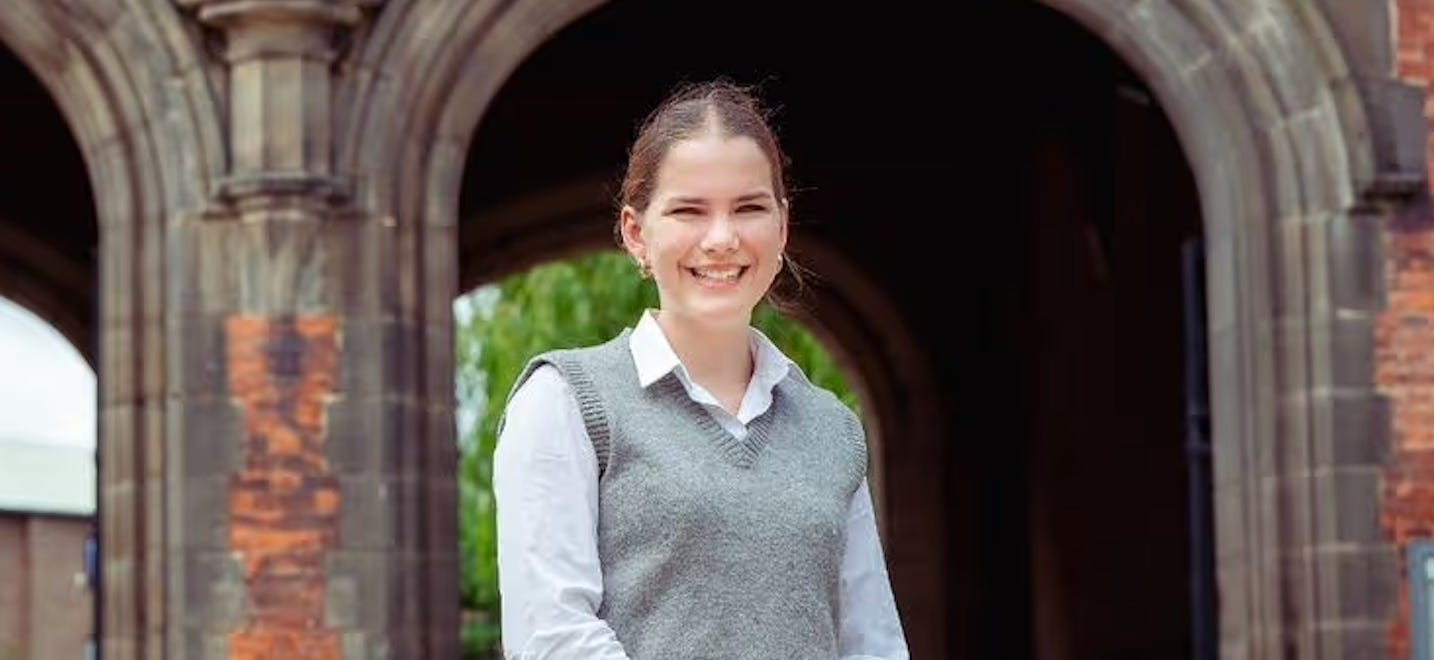
Elsewhere, one of our most clicked stories of 2026 came by way of young entrepreneur Henrietta Newble. The Newcastle University student has launched an animal health tech start-up that has raised £40,000 in early stage funding.
Moreover, last week we profiled Hartlepool’s Kelly Whitfield. Kelly is the founder of KLIK SaaS, a startup which has secured £300k in investment as it prepares to take its community-building platform to market.
Inspiration comes in different forms. I’m convinced that there are many more examples of brilliant, cutting-edge, purpose-driven work happening across the ecosystem but are going under the radar. Untold stories. If you know of them, tell me. Let’s write about them!
It’s International Women’s Day on Sunday. Naturally for the tech media, IWD provides a topical/useful moment to focus attention. Equally, we know ecosystems change through consistent behaviour, not calendar moments alone. So it’s been great to see pillars of the region’s tech ecosystem, from growing employers to established networks, bring communities together in event-spaces to offer support this week, as they often do. Heck this cynic has even seen some lush stuff on LinkedIn!
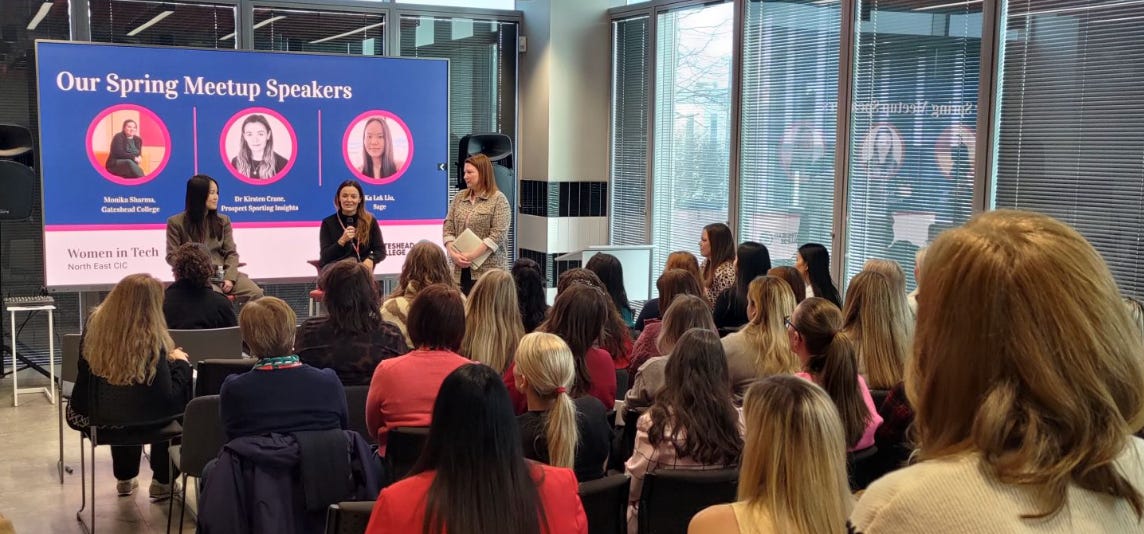
To give you a flavour of important activity, Women in Tech North East were at Gateshead College. Monika Sharma, Dr Kirsten Crane and Ka Lok Liu were on hand to provide inspiration regarding ‘squiggly careers’ and getting into the tech industry. Meanwhile Sunderland Software City are today putting on a hands-on, practical skills and knowledge workshop around data science, led by female operators in the space.
When we zoom out and consider what’s happening on the world stage, I’m talking everything from the five year anniversary of Sarah Everard’s murder to the stripping of basic human rights in the Middle East, I appreciate it can feel almost trivial to talk about representation on tech panels or venture funding percentages, as I’m about to do.
The reality, however, is a bit more nuanced. We should acknowledge that gender inequality exists on a spectrum globally, absolutely. The UK tech sector’s issues are not the same as human rights crises, yet they still matter within our context. It’s a truth that we can care about both global injustice and local systemic improvement.
So today, I’m going to talk about the stat we all love to hate. Yup. We’re going big on the 2%. Today I am not talking about everything happening in the world, I am talking about female-led venture-building in North East England.
Beyond the 2%: Moving the dial for women‑led tech companies
Yes folks, International Women’s Day tends to bring a familiar statistic back into circulation: only around 2% of UK venture funding goes to women‑led businesses. This is a real number. It’s important. But it’s one I don’t want to simply blindly repeat to you today and say hey, we’ve got to do more.
If we genuinely want to improve outcomes for women building tech businesses, we need more precision. More system design. One of the wanky, pretentious phrases I tend to lean on in policy circles and in papers I write is ‘systemic change’. Hey reader, you give a hipster a keyboard…
What I mean by this is we give precedence to changing the underlying structures that shape outcomes, not just the visible symptoms. Now, we can do both simultaneously. We can champion and challenge. We can push forward with micro actions as well as macro. Ultimately though, change that is systemic is most meaningful. Of course, it’s also the most difficult to enact too.
My piece today is an attempt to face this difficulty. It probably won’t just annoy my ‘Jamie you’re giving too much air time to this stuff’ readers but also those of you passionate in this space with much experience, knowledge and ideas. This is a free newsletter. It’s not my intention to garner clicks or prestige or upset. I’m sharing with you how I see things, albeit from a very privileged position. This isn’t meant to offend but I do hope it provokes conversation and change.
First I think it’s necessary to slow the conversation down, de‑conflate different types of businesses, before we ask harder questions about where intervention actually makes a difference.
Not all women‑led tech businesses are the same
We do ourselves no favours by treating ‘women founders’ as a single, homogeneous group. Rather, in practice, there are at least two very different categories that often get collapsed into one:
1. High‑growth, equity‑backed tech businesses
Companies designed from day one to scale aggressively, raise external capital and pursue large exits.
2. Digitally enabled lifestyle businesses
Profitable, sustainable companies using technology as an enabler rather than the product. Such businesses are often services‑led, sometimes intentionally small, and are hopefully, frequently cash‑flow positive.
Both are valid. Both matter to a healthy regional economy. But they have different business models, different risk profiles and critically, require different kinds of support.
The tech sector can be difficult to define, as well as access. Breaking down barriers is a responsibility. So too, I feel, is understanding the sector’s discourse and meaning. Investment and grants aren’t interchangeable synonyms. Yet they’re often used as such. Similarly not every startup is a tech startup. Or not every digital growth programme is a high potential accelerator. This matters when we talk about what problems we’re trying to specifically solve.
When we quote venture funding statistics without making this distinction, we create confusion. Lifestyle businesses are not ‘failing’ because they don’t raise VC. Many never intend to. Meanwhile, scale‑ups do live or die by access to capital and that’s where our coveted 2% figure is most terrifying.
If we want to be serious, we have to be clear about which problem we’re trying to solve at any given moment.
The 2% problem is real but it’s not the whole story
I read this Bdaily article from my friend Nina Walton earlier this week. Nina and the people involved are great, I support their bid to drive use of data (whatup my fellow nerds), unlock innovation and combat gender divisions in business funding.
What interests me, on a macro level, is strategy. As I say, we are more than familiar with the recurring 2% headline. What we don’t have is alignment on the objective.
You and I will no doubt agree that the meagre 2% distribution is abysmal. It should be more. Though I do wonder what does ‘more’ really mean? Should women‑led businesses receive:
4% - double?
23% - in line with sector representation?
50% - in line with global demographic representation ?
Remember, I’m getting at systemic change. Systems operate with targets. And yet, in this space, too few seem willing to state what success actually looks like. It’s a challenge I have with the current piece of work I’m doing on the region’s AI ecosystem. People struggle (and give me wildly varying answers) as to what our national AI startup representation should be, for instance. All agree higher than the current 1.3% but that only takes us so far.
Without that clarity, initiatives drift. Boards are formed. Events are held. Panels are balanced. But nothing structural changes.
Is the funding gap the cause or the symptom?
Another reason the conversation stalls is that we often treat funding as the primary failure, rather than a downstream outcome. We recently shared Paul Smith’s excellent article ‘Access to finance, faster horses, and the North East’s startup problem’ where he explores the pipeline reasons as to why the North East has a tech startup problem. This bears relevance here.
Let’s take another look at the aforementioned bdaily article and the the regional data it cites:
71% of NE funded companies are male‑led
14% are evenly led
12% are women‑led
Clearly, that distribution doesn’t start at the investment committee. It reflects what flows into the system.
So we need to ask, honestly, where do constraints actually sit:
Are fewer women starting tech businesses in the first place?
Are women founders receiving less non‑financial support (mentoring, networks, visibility, sponsorship) at early stages?
Does STEM participation, and therefore eligibility for large‑ticket, deep‑tech investment, skew the pipeline long before funding conversations begin?
Is the VC industry itself too homogenous in background, pattern recognition, and risk appetite?
Do cultural factors, confidence gaps, caring responsibilities, social conditioning, systematically penalise women in pitch‑led environments?
The answer, inconveniently, is all of the above. It’s noble to tackle any of the puzzle’s pieces. It wouldn’t be wrong, for instance, to spend your Saturday mornings mentoring young girls. Please don’t misinterpret me. But viewing the problem holistically, i.e. in pipeline thinking, is what’s needed.
Inevitability and pipeline
What I’m getting to isn’t tremendously novel but it’s what I don’t quite see enough of when I encounter the typical 2% articles and blogs that flood the internet in and around IWD. The lack of funding for women‑led tech businesses is a second‑order effect of there being too few inevitable companies overall.
Regions like ours do not yet have a deep, consistent pipeline of investment‑ready tech businesses, male or female. We have pockets of excellence, absolutely, but not volume.
If the total pool is shallow, representation debates become zero‑sum. Everyone competes for the same scarce attention. Slow progress, rising frustration and even, you guessed it reader, potential changemakers becoming disfranchised.
This brings me back to numbers, objectives and… strategy. System design. I have my own biases, I’m very goal-orientated as an individual, how I see the world isn’t necessarily the ‘right’ way but to me at least it makes sense, when aiming for a well‑functioning pipeline of investable tech companies, to declare what proportion should be women‑led and what needs to change upstream to make that true.
What would actually move the dial?
Here’s a few things which I’d like to see happen. There’s no silver bullets here or one off levers to pull, rather much of this is culture. Change can happen through osmosis.
1. Set explicit, public goals
As above. Actual targets, tied to timeframes, with accountability attached.
2. Invest earlier in the pipeline
More structured pre‑seed and pre‑investment support for women founders: customer access, technical validation, confidence‑building and founder‑level coaching. I am talking specific support for venture backed companies in immature ecosystems. That’s no shade on support for digitally enabled businesses getting acquainted with the foundations of running a business, rather it’s understanding bespoke needs of high-potential stock.
3. Treat non‑financial support as infrastructure
Networks for tech operators, peer groups, role models, and access are often framed as ‘nice to haves’. They compound over time and materially affect outcomes. We say this every week but community matters.
4. Stop conflating business types (especially in funded comms campaigns)
Celebrate profitable lifestyle businesses on their own terms. Don’t measure them against VC metrics they never opted into.
5. Champion the investor side too
Diversity in decision‑making bodies isn’t virtue signalling. It changes what gets funded.
6. Build volume
More founders! More experiments! More failures! Just… more shots on goal. Representation improves when ecosystems mature, the curve ain’t always linear but the more, the merrier right?
As I say, systemic change.
Listen to… women
Aaaaaand now to watch me drown in irony…
I’d encourage any national or local policy maker or ecosystem stakeholder to read this recent essay by Laura Richards, “A message to women founders: you’re not lucky to receive investment.”

Laura tells us that for years the conversation around women founders has often implied that the problem lies with women themselves: pitch better, be more confident, find a technical co‑founder, build a stronger network. Meanwhile the headline statistic barely moves. Hey what is it again? Roughly 2% of venture capital has gone to women‑led companies for more than a decade.
Laura then points out something that again isn’t always understood in the startup ecosystem: venture capital is a portfolio game. Investors spread their bets across many companies knowing most will fail. Founders do not have that luxury. For them the company is not one of ten bets, it’s their single shot. I’m talking everything… their reputation, finances, relationships and wellbeing are on the line.
That creates a strange dynamic in startup culture where founders are often encouraged to feel grateful for investment, even though investors are ultimately buying access to the upside of the founder’s risk and labour.
The research she cites is even more terrifying. Studies examining male and female co‑founders who built the same companies show that after failure, women are significantly less likely to secure funding for their next venture and raise less capital when they do. Men, by contrast, often raise more after failure. Even after successful exits, women still face worse odds in their next raise.
I’m hammering this home to death now but this is why we need to go beyond the shock factor of just repeating our persistent 2% figure! It doesn’t just reflect a pipeline issue, it suggests something deeper about how risk, credibility and pattern recognition operate inside venture capital.
Again, pre-empting angry emails, I’m not calling all investors villains. Venture capital is designed to work the way it does. But it does mean founders, particularly female, should feel empowered to treat investment as a partnership negotiation, not a favour being granted.
Here’s where I’m at
When I talk about this stuff I sometimes upset the people I want to help, as well as the people I want to take to task! I acknowledge differing efforts and I don’t have all the answers, nor do I have one iota of how YOU might feel being a woman trying to succeed in tech. Rather, here’s what I believe I know:
International Women’s Day, through the lens of tech ecosystems, shouldn’t only be about recycling statistics we already know. The 2% headline is important but as Laura argues, repeating it for ten years now doesn’t seem to be truly moving the dial. I think we need to be brave enough to interrogate the system.
If nobody is willing to dig into root causes, set real objectives, and design interventions that reflect how businesses actually grow, then maybe cynicism is a rational response. But if we are willing to do that work properly, then this isn’t a bleak story at all. It’s a story in motion and one we can redesign.
Thanks for reading today. We’ll be back with a ‘normal’ issue of news and nonsense two weeks today on Friday March 20th. Have a lovely weekend, Jamie
Yes yes yes.
Here for interrogating the system (as you know). And for chats with anyone that wants to actually create systemic change (by listening to people who actually understand the problem… or is that too much to ask?!)
Thanks for including some of my thoughts!